Alex Noonan
Senior Developer Experience Advocate
View all authors

Have dbt skills been bitter lesson’d?

· 20 min read
Alex Noonan
Senior Developer Experience Advocate
The grim reaper, labeled The Bitter Lesson, has already visited the doors marked Natural Language Processing and Prompt Engineering, and is now knocking on the door marked SkillsThe grim reaper, labeled The Bitter Lesson, has already visited the doors marked Natural Language Processing and Prompt Engineering, and is now knocking on the door marked Skills

Do you remember what it was like trying to code with AI this time last year? The models could write SQL, but their judgment was poor. They skipped many of the signals of tradecraft that skilled analytics engineers have. Skills were the intuitive fix: give the agent the knowledge it needs for this task, without starting from zero every time or stuffing one AGENTS.md with everything that might come up. Skills arrived for Claude in October 2025 and became an open standard that December. We built our own set of dbt agent skills to give coding agents the conventions, commands, and patterns they were missing.

Models have improved a lot since then, and one must always remember the Bitter Lesson for AI, where being too clever is a losing strategy compared to just pointing more computing resources at the problem. So I wanted to check whether that bet still holds. Can the latest models build and maintain a dbt project at real-project scale without skills? And if they can, where do skills still earn their place?

I spent an afternoon or two building a proof of concept eval to find out: 22 agent runs, up to 12 tickets each, on a Formula 1 dbt project in Snowflake. I found that the difference between good runs and bad ones was process, not dbt knowledge. I wouldn't call that conclusive, but in an environment moving this fast it has changed how I think about skills.
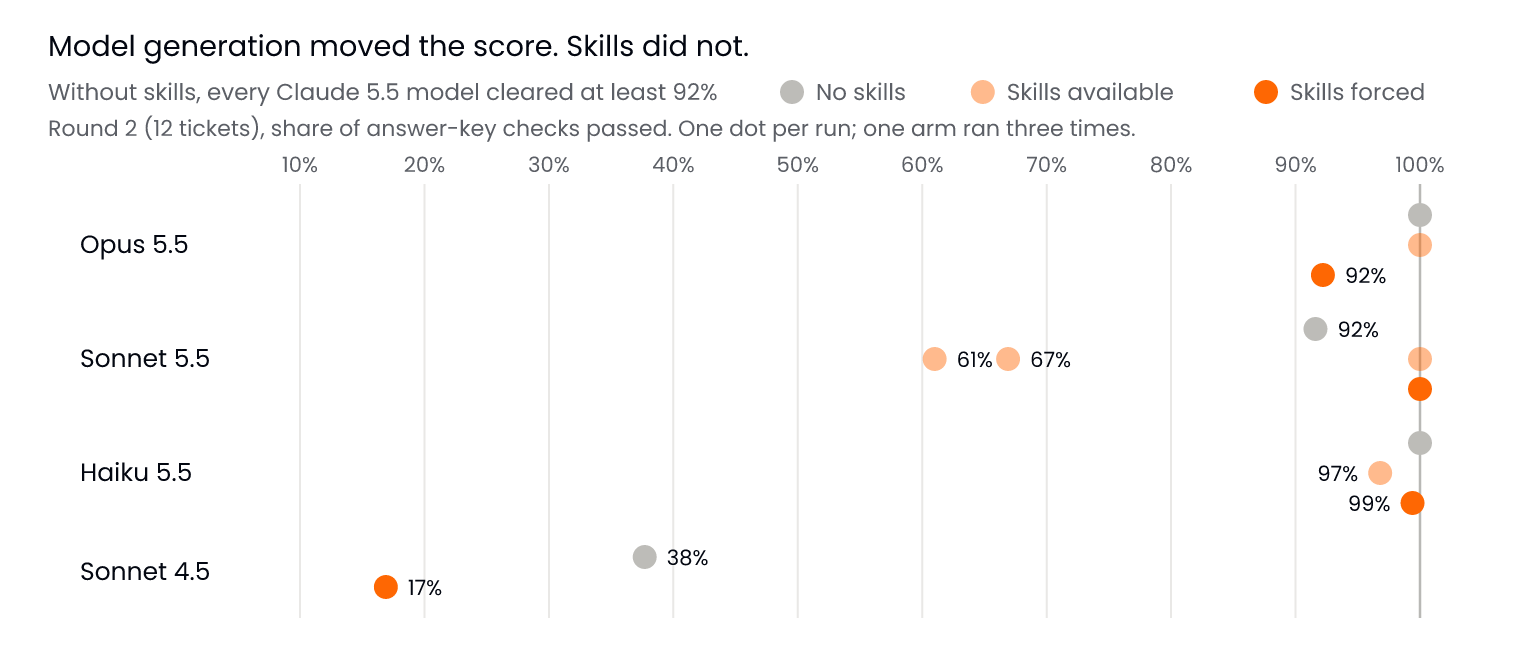
Round 2 checks passed by model and arm. Model generation moved the score; skills didn'tRound 2 checks passed by model and arm. Model generation moved the score; skills didn't
  • Run-to-run variance is bigger than any skills effect. The same arm, Sonnet 5.5 with skills available, scored 61%, 100% and 67% on three runs.
  • The 5.5 models already know dbt. 12 of 19 Claude 5.5 runs passed every check, and without skills every 5.5 model cleared at least 92%.
  • Agents rarely opened a skill on their own, and when they did, it was most often for unfamiliar ground like the Semantic Layer or dbt Mesh.
  • A model generation is worth more than a skill. Sonnet 4.5 scored 38% without skills and 17% with them forced, the two lowest scores of any run, and the forced run had read the skills before it wrote its first model. (The Bitter Lesson.)
  • Process failures dominated: a test that froze today's answers, failed backup attempts, ignoring definitions, miscalibrated lookback windows.

If you maintain skills for a team: cut the docs that explain how dbt works, keep the ones covering features that aren't fully integrated into your stack, and write new ones for how your team tests, deploys, and reviews. Going forward, teams that understand their process and how to support and improve it will be in a much stronger position to leverage frontier models.


Inside the dbt Wizard harness: building an agent that thinks in DAGs

· 15 min read
Jason Lin
Senior Software Engineer
Alex Noonan
Senior Developer Experience Advocate
Sam Ferguson
Staff Product Designer

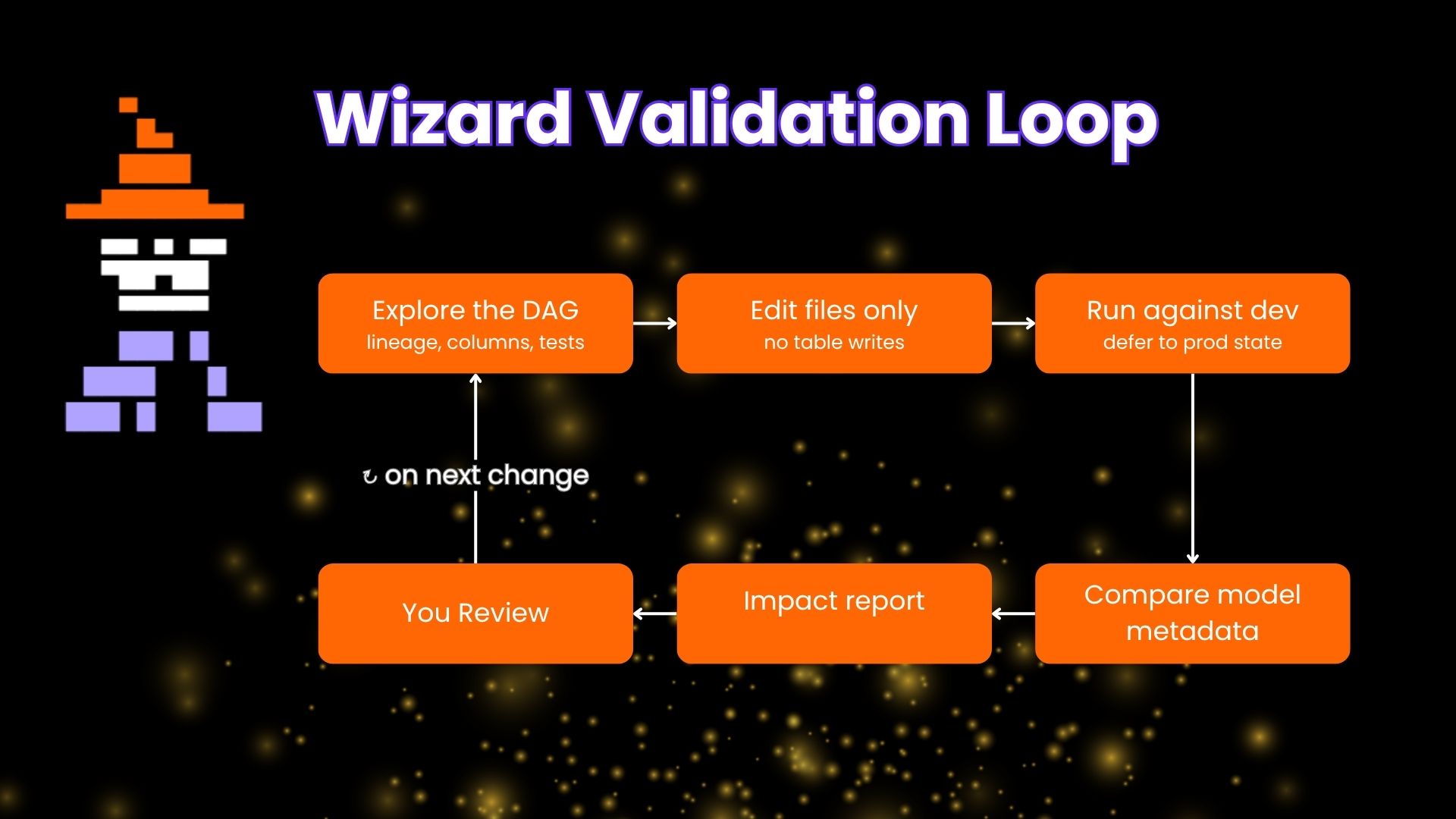
Ask an analytics engineer to rename a column and they won't start with the SQL. They'll check what reads it downstream, which tests and dashboards will break, build only what changed, and compare the data before anyone reviews it. The dbt MCP server and agent skills can teach a coding agent those steps, but they can't make sure it follows them every time, builds on what's changed, or shows you the data diff before you review the changes.

We built dbt Wizard around a different idea. Wizard works like an analytics engineer: it thinks in DAGs, tests and fixes its own work, and keeps you in flow, so you review a working change instead of a first draft. None of that comes from the model; it comes from the harness, workflows, and UX we built around it.

Try Wizard Desktop

Run parallel agents, review data diffs and lineage next to the code, and validate changes against your warehouse. Join the Wizard Desktop waitlist.

The dbt MCP server comes to Claude: governed context, one sign-in away

· 8 min read
Alex Noonan
Senior Developer Experience Advocate

When we open-sourced the dbt MCP server in April 2025, it was an experimental, locally hosted project with a clear thesis behind it: structured data is going to be deeply integrated into AI workflows, and dbt is the layer that provides the governed context those workflows run on. Anthropic has helped validate our thesis. Naturally, it made sense to have a cloud-hosted version with remote OAuth, so you can use it with whatever AI tool you are most comfortable with.

The remote dbt MCP server now runs inside the dbt platform, and you can connect it to Claude in a minute or two by signing in and completing the authentication flow. You add dbt as a connector, approve the access you want, and Claude gains access to your governed data and rich dbt metadata.

This post walks through what the remote server brings to Claude, the types of workflows it fits into for both people and agents, and how the tools compose once they share a conversation.

No babysitting, not today

· 9 min read
Alex Noonan
Senior Developer Experience Advocate

We recently released dbt Wizard, a CLI for doing agentic data work on dbt. This is a harness specifically built for data work and as such I was excited to spend an afternoon running dbt Wizard across a personal project with about 100 models or so that I've been maintaining for a while. You can use this project to see firsthand some of the differentiators for Wizard, particularly how the validation loop works.

Data projects are never done and I had a few tasks I've been putting off:

  • Migrating from MotherDuck to Iceberg + BigQuery
  • Upgrading dbt Core to dbt Fusion
  • Migrating from dbt Core to dbt platform
  • Building out a semantic layer

These are a good mix of pretty standard data work (have you done your annual migration yet?) and some dbt specific tasks. A good informal eval for the fundamental question for any dev tool: Does it work?

I was pleasantly surprised with my experience in that I didn't have to babysit Wizard or build any additional workflows on top of it. Because it has a native understanding of what a dbt project is, and its ability to set up validation subagents that match the task made it easy for me to just pop in when needed and I didn't have to babysit the whole process and I accomplished all of my objectives.

a loop showing how wizard validates changes